
Member Spotlight: Keith Benson on Anzhelina & Karina
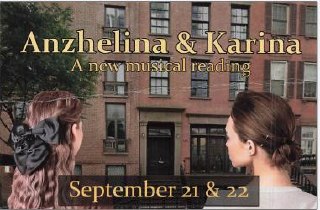
NMTE’s first member spotlight — a conversation between Charlie Betz and Keith Benson about the development of Keith’s original musical, set against the turbulent backdrop of 1919 New York City.
Charlie: Keith, I’ve really enjoyed watching your progress on Anzhelina & Karina. It’s not necessarily easy to do historical content of this nature. As a student of political science and history, I’ve certainly learned a few things about the cultural dynamics going on in the years that musical is set in. Why don’t you start us from the beginning — the basic premise, and how it came to you?
Keith: It came to me learning the history. I enjoyed learning of that time. It takes place in New York City, 1919 and 1920, and there was a lot going on — especially with the war coming to an end and the labor concerns. Really, a labor war between the rich and the immigrants. In this case, immigrants from Russia is what this story is about.
I really wanted to use that part of the history. In the musical, there’s an event of a raid on a Russian union, an explosion on Wall Street from an anarchist concerned about labor. Those events occur in the show. But the story isn’t really about that — it’s about two young women who meet again in New York after spending years together in Russia when they were very young.
One was around 8 years old, the other around 15, when the younger one ended up moving to the United States. Karina is the girl who was younger in Russia, and Anzhelina was the older one — kind of like a big sister, a mentor, someone who really took care of her.
When they meet again in New York, Karina is really hoping that things can be as they were. But Anzhelina, who had lived through World War I as a Sister of Mercy, was a completely changed person and could no longer give Karina what she wanted.
Charlie: So Karina wanted the relationship to be the way it was back in Russia. It’s almost a coming-of-age theme, which can be very bittersweet — when people are confronted with that kind of emotional change that they have to navigate.
Keith: Right, and New York made it harder. Had they come together in a small community, things might have been great. But they came together in a very difficult spot in the Lower East Side, where so much was going on — the anarchy, the labor wars, the Spanish flu, the poverty, tenement homes with multiple families. It was a very difficult time. And Anzhelina especially felt this need to help others as a nurse, someone who was really devoted to caring for people.
Charlie: Writing musicals in and around known historical facts — it’s like you’re in this forest where there are these big trees, and the trees are what they are, you can’t move them. But the story is also not about the trees, because those are well-studied. It’s not a history lesson. How do we navigate as creators around these big trees and use them to our advantage, but don’t turn the creative product into just commentary on history — really just use it as scaffolding?
Keith: That is something I’ve had to adapt to. If I look at the beginning of the project, the front and center were more the events — the raid on the union, the bombing of Wall Street. But it wasn’t meant to be about that. So there was a constant adapting to get these trees, as you put them, out of the story and make it about the two women. When it works, it’s pretty cool to be able to talk about things that happened in real-life history — when the history gets out of the way.
Charlie: Last year you had a private reading, and two well-attended sessions of a public reading. I was at one. What’s next for the musical? Are you editing, revising, moving on to new ideas?
Keith: As you know, musicals — you’re always revising, right? Until you’re not, I suppose. I learned a lot from the reading. It was the first public reading, and often musicals will go through a number of readings. I learned enough to be doing updates from September until now. I’m hoping to be done with my latest round of updates in the next month or so.
I am very anxious to work on a new project, I gotta say. At some point, one’s gotta put it aside — for a couple of reasons. One is I don’t think it’s that valuable to continue to work on something indefinitely, but also for personal growth. It is important to do new things.
Charlie: Absolutely. Well, this has been a great conversation, and it’ll be a great first blog.
Keith: Thanks for the opportunity!
Keith Benson is a member of NMTE. Anzhelina & Karina had its public reading in September 2025 at the Center for Performing Arts in Minneapolis.